The Hurricane Question Every Palm Bay Transplant Asks (And the Honest Answer)
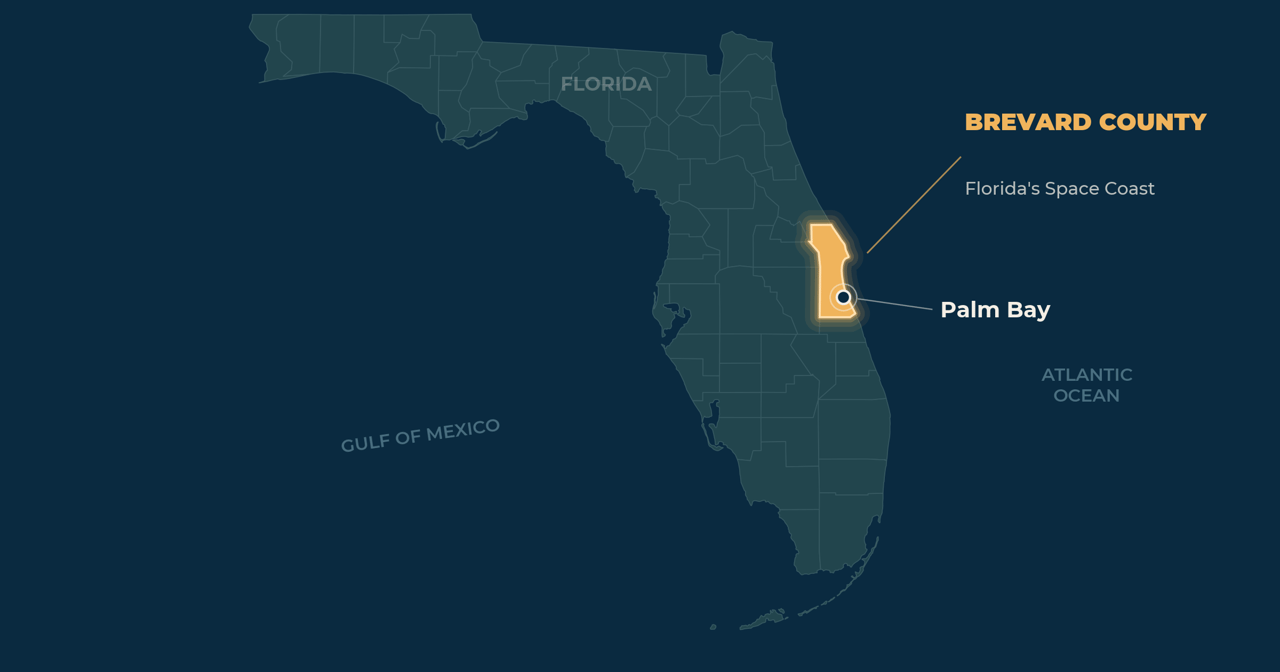
If you are moving to Brevard County from out of state, there is a good chance one worry is quietly running in the background: hurricanes. And it makes sense. Everything you have ever seen on the news is Miami underwater or a Panhandle town flattened. Florida and hurricanes are basically a package deal in the national imagination.
So here is the honest, fact-checked version for people looking at Palm Bay, Melbourne, and the rest of the Space Coast. Not the sales-brochure version. The one you can actually verify.
Let me start with the stat that surprises almost everyone.
Since 1851, a major hurricane has never made a direct hit on Brevard County
That is not a marketing line. It is what the record shows.
The official Atlantic hurricane database, called HURDAT2, goes back to 1851. Across all of that time, no major hurricane, meaning Category 3 or stronger, has ever crossed Brevard's coastline with its eyewall on our beaches. The National Weather Service office in Melbourne and local reporting that leans on their storm summaries back this up, and Brevard's own emergency management history tells the same story.
Quick definitions, because "direct hit" and "major hurricane" both get thrown around loosely:
The Saffir-Simpson scale ranks hurricanes 1 through 5 by sustained wind speed. Category 1 starts at 74 mph. A "major" hurricane is Category 3 (111 mph) and up. That is the line where wind damage stops being a repair bill and starts being a rebuild.
A direct hit means the storm's core, the eyewall where the worst winds live, actually comes ashore over you. A storm passing 30 miles offshore is a very different animal than one parking its eye on your roof.
Put those together and the record is clear: plenty of storms have affected Brevard, but the truly violent ones have consistently made landfall somewhere else, or stayed out over the water, or fell apart before they got here.
Now, the honest caveat, because credibility is the whole point. The older end of that record, roughly pre-1900, comes from ship logs and coastal observers, not aircraft and satellites, so the 1800s data is thinner than what we have today. And "no direct major hit" does not mean "no impact." It absolutely does not. We will get to the storms that hurt. But the headline holds up: in more than 170 years of records, Brevard has never taken the eyewall of a Category 3 or stronger.
So why does the Space Coast keep dodging the worst of it?
Why Brevard tends to get spared (in plain English)
There is a local nickname for the slight eastward jog in the coastline near Cape Canaveral: the "Brevard Bump." You will hear people say the cape "pushes storms away," almost like a force field.
I am going to be straight with you. A little bend in the coastline does not physically shove a hurricane the size of a state off its path. That part is folk science. But the pattern of Brevard getting spared is real, and there are three actual reasons behind it.
One: the coastline runs the same direction the storms travel. Atlantic hurricanes approaching Florida's east coast very often curve northward and ride up the coast rather than plowing straight in. Brevard's shoreline runs roughly north to south. So when a storm parallels the coast, its eyewall can stay just offshore the entire time it passes us. That is geometry, not luck, and it is exactly what happened with Matthew in 2016.
Two: storms from the Gulf have to cross the whole peninsula to reach us. A hurricane that slams into southwest Florida has to grind across 100-plus miles of land before it gets to Brevard on the east-central coast. Land is a hurricane's enemy. It cuts off the warm-water fuel and chews up the structure. By the time these storms reach us, they are usually a shadow of what made landfall. Ian in 2022 is the textbook case.
Three: the warm-water conveyor belt sits farther out here. The Gulf Stream, which is basically high-octane fuel for hurricanes, runs closer to shore down in South Florida and farther offshore by the time you get up to Brevard. A storm approaching our coast is running on slightly weaker fuel in its final hours.
None of this makes Brevard hurricane-proof. It makes Brevard statistically less exposed to the catastrophic direct hit than South Florida or the Gulf Coast. Big difference, and an honest one.
The storms that prove the pattern (including the ones that hurt)
I am not going to pretend Brevard is some tropical safe room. We have taken real punches. The pattern is not "nothing happens here," it is "the knockout blow keeps landing somewhere else." Here are the receipts.
The 2004 double: Frances and Jeanne. This was the worst stretch in Brevard's modern hurricane history, and it is the closest call on record. Hurricane Frances came ashore September 5 as a Category 2 on southern Hutchinson Island. Three weeks later, almost unbelievably, Hurricane Jeanne made landfall within a few miles of the exact same spot as a Category 3, with 120 mph winds. Here is the nuance that makes the headline stat trustworthy: Jeanne was a genuine major hurricane, but it came ashore at the Martin and St. Lucie county line, roughly 40 to 50 miles south of the Brevard border. Brevard still got hammered with major-hurricane storm tide and wind, Melbourne broke rainfall records, and beaches got shredded. But the eyewall of that Category 3 landed south of us, not on us. That is the difference between "affected by" and "direct hit."
Hurricane Matthew, 2016. This one gets a lot of attention because it was terrifyingly close. Matthew tracked north as a major hurricane with its eyewall skimming just offshore of Melbourne Beach, Satellite Beach, and Cape Canaveral. Wind gusts topped 100 mph on the barrier island, homes were damaged, and A1A flooded. And yet Matthew never actually made landfall in Florida at all. Its only U.S. landfall came later, up in South Carolina, as a weakened Category 1. Matthew is the clearest example of the coastline geometry working exactly as described: a major hurricane paralleling the coast, eyewall staying just out over the water. Local track records put its closest approach right off our beaches.
Hurricane Ian, 2022. Ian was a monster, a Category 4 that devastated the Fort Myers area on the Gulf side. By the time it crawled across the peninsula and reached Brevard, it had collapsed to a tropical storm with winds around 65 mph before moving offshore near Cape Canaveral. We got downed power lines, some flooding, and a scare. Southwest Florida got a catastrophe. Same storm, wildly different outcomes, entirely because of that land-crossing weakening.
Hurricane Nicole, 2022. A rare November hurricane, Nicole made landfall as a minimal Category 1 near Vero Beach, then crossed through western Brevard. The main story here was beach erosion on top of already-thin sand, not widespread structural destruction.
Hurricane Milton, 2024. Another Gulf entry. Milton hit the Sarasota area as a Category 3, crossed the state, and passed near Brevard as it exited into the Atlantic, weakened well below major strength. Familiar pattern by now.
Read that list again and the shape of it is obvious. The major hurricanes either hit somewhere else, brushed us from offshore, or fell apart crossing land. That is the pattern, storm by storm.
So why don't Palm Bay homes have impact windows like Miami?
If you have spent time in South Florida, you have seen it: every window and door rated to survive a missile test, hurricane shutters as a way of life. Then you tour a newer home in Palm Bay and notice a lot of standard windows. What gives?
It comes down to a line on the map called the High-Velocity Hurricane Zone, or HVHZ.
After Hurricane Andrew flattened parts of South Florida in 1992, the state completely overhauled how it builds. That effort led to a statewide building code that took full effect in 2002, one of the toughest in the country. But it also created a special tier, the HVHZ, for the areas facing the most extreme wind risk. The HVHZ covers exactly two counties: Miami-Dade and Broward. In those two counties, homes have to be designed for roughly 170 to 175 mph wind loads, and every window and door has to be impact-rated or protected by an approved permanent shutter system. That is why South Florida looks the way it does.
Brevard sits outside the HVHZ. Our coastal areas fall under what is called the Wind-Borne Debris Region, which still has serious requirements but sets the design wind speeds lower than Miami-Dade and Broward. That is the honest reason you do not see impact glass on every Brevard home: the code down there is built for a level of risk our county's history and wind maps do not carry.
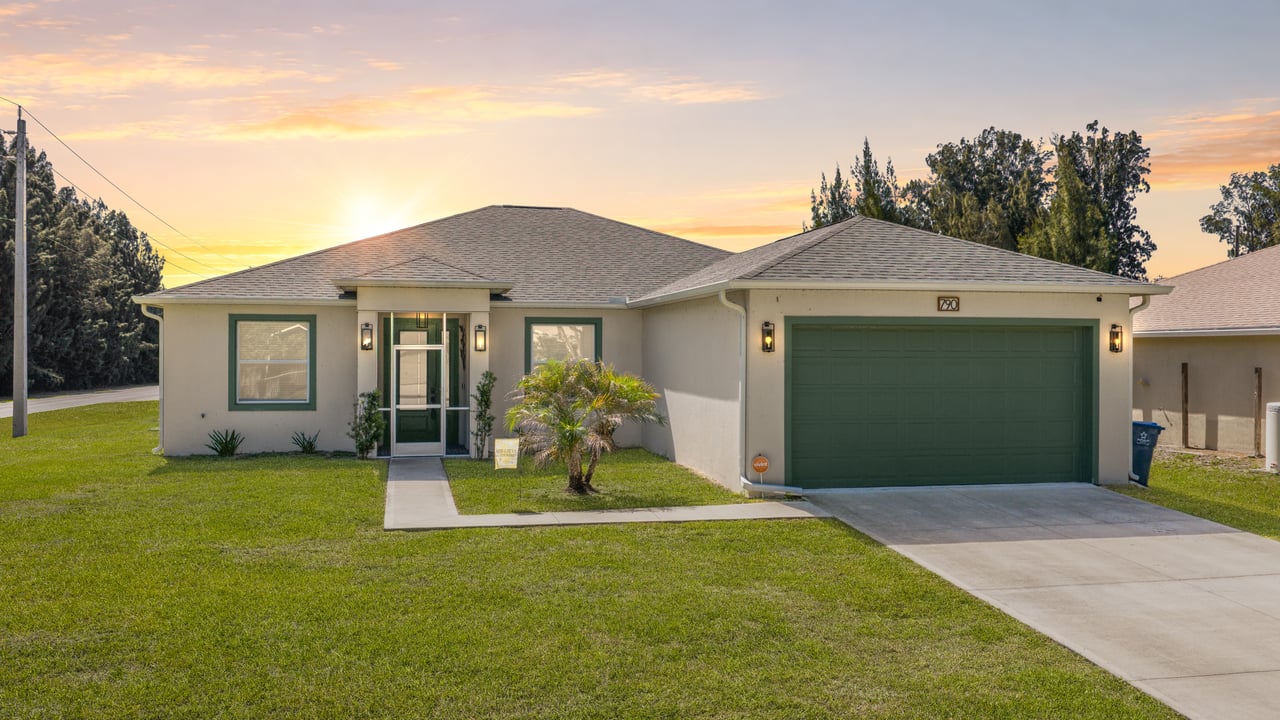
That does not mean Brevard homes are unprotected. Not even close. A modern Palm Bay build to current Florida code includes hurricane straps or clips tying the roof to the walls, a sealed and reinforced roof deck, and code-approved windows and doors, with many homeowners adding accordion or panel shutters on top. It is a different standard than the HVHZ, matched to a different level of exposure. And one more thing worth knowing: Florida's building code keeps tightening. The next edition, taking effect in early 2027, expands stronger requirements to more coastal areas statewide, so the gap between zones is narrowing over time.
Why insurance in Palm Bay runs lower than South Florida (especially on new construction)
Here is where the geography quietly shows up on your bank statement.
Florida homeowners insurance is expensive statewide, no sugarcoating that. But it is not one price. It is wildly local, and the biggest single driver is your exposure to hurricanes. Roughly speaking, the windstorm portion alone can make up 40 to 55 percent of a Florida premium, so where you sit relative to hurricane risk moves real money.
The rough picture, using recent county-level reporting tied to Florida Office of Insurance Regulation and Citizens data:
- Brevard / Space Coast: commonly in the neighborhood of $4,000 to $4,300 a year for a typical single-family home.
- Miami-Dade: averages pushing past $6,000, with plenty of coastal homes well above that.
- Broward, Palm Beach, and the Miami metro: frequently $6,600 to $7,000-plus, with the Keys (Monroe County) topping the whole state.
Treat those as ranges, not quotes, because your actual number depends on the specific home. But the pattern is consistent and it is meaningful: the same coverage often costs noticeably less in Brevard than in the South Florida counties, and the hurricane-exposure difference is a big reason why.
And this is not just theory for me. On the real estate I own personally here in Palm Bay, my own insurance runs under $2,000 for the year. When I am helping clients buy new construction, I regularly see full-year policies come in between $800 and $1,500. Those are the kinds of numbers that genuinely stop South Florida transplants in their tracks, because down there a single year of coverage can cost more than three or four years of it up here.
Now the part that matters most if you are eyeing new construction in Palm Bay, which we have plenty of.
Newer homes get better rates, and it is not a favor, it is the law. Under Florida Statute 627.0629, insurers are required to give premium credits for verified wind-resistant construction features. A home built to post-2002 code already has the features that earn those credits: reinforced roof-to-wall connections, a properly attached and sealed roof deck, and code-approved opening protection. In fact, several major carriers automatically apply default wind credits to homes built after 2002.
The tool that unlocks the full discount is a wind mitigation inspection, documented on a standard state form. A licensed inspector verifies your roof shape, roof deck, roof-to-wall connections, and opening protection, and the insurer is legally required to knock the corresponding credits off your windstorm premium. Those credits can shave a serious chunk off the largest part of your bill. On a brand-new Palm Bay home, a lot of that value is baked in from day one. There is even a state program, My Safe Florida Home, that has offered free inspections and matching grants to strengthen homes further.
Bottom line for a buyer: a new build in Palm Bay tends to hit the sweet spot of lower regional risk plus current-code construction plus maximum wind credits. That combination is a big part of why your insurance quote here will often make a South Florida buyer do a double take.
The grounded truth for someone making the move
Let me land this plane honestly, because you deserve the real version, not a pitch.
No place in Florida is hurricane-proof. Anyone who tells you otherwise is selling something. Brevard gets tropical weather. We evacuate coastal zones sometimes. We lose power. Beaches erode. Every few years a storm gets close enough to make your stomach drop. That is the cost of admission for living in one of the best coastal spots in the country, and you should walk in with eyes open.
But here is the accurate risk picture, stripped of both the doom and the spin. In over 170 years of records, Brevard has never taken a direct hit from a major hurricane. The geography genuinely works in our favor. Storms weaken crossing land to reach us, and the ones running up the coast tend to keep their worst winds offshore. The building code is solid, newer than most, and getting stronger. And the insurance math, especially on new construction, is meaningfully friendlier here than in the South Florida markets people picture when they think "Florida hurricane."
What the risk actually is: real but manageable, and lower than the mental image most transplants arrive with.
What it is not: the wall-of-water, city-underwater scenario the national news trained you to expect from watching Miami and the Panhandle.
So if you are moving here, do the smart-resident basics and then go enjoy the Space Coast:
- Know your evacuation zone. Brevard's are easy to look up by address. Coastal and barrier-island zones evacuate first, and inland Palm Bay is a different situation than oceanfront Melbourne Beach.
- Get a wind mitigation inspection if your home does not already have a current one. It can lower your premium immediately, and it is required to be honored.
- Understand flood versus wind coverage. They are separate policies, and knowing which zone your home sits in matters more than almost anything else.
- Have a basic plan and a few days of supplies. Not a bunker. Just the normal readiness any coastal resident should keep.
Do that, and hurricanes become what they actually are for most Brevard residents: a few tense days a year to prepare for and respect, not a reason to cross the Space Coast off your list.
I help people relocating to Palm Bay, Melbourne, and the wider Space Coast get the real picture on neighborhoods, new construction, and everything from insurance to evacuation zones. Questions about a specific area or home? Reach out anytime.
Donell Knight II | Blue Marlin Real Estate | 321.492.0435 | SpaceCoastbyDonell.com
Sources
- National Weather Service, Melbourne FL office, Hurricane Jeanne summary: https://www.weather.gov/mfl/jeanne
- National Weather Service, Melbourne FL office (main): https://www.weather.gov/mfl/
- Florida Department of Environmental Protection, Hurricane Frances and Hurricane Jeanne report: https://floridadep.gov/sites/default/files/HurricaneFrancesHurricaneJeanne.pdf
- Florida Department of Environmental Protection, Hurricane Jeanne characteristics and storm tide evaluation: https://floridadep.gov/sites/default/files/HurricaneJeanneCharacteristics-StormTideEvaluation.pdf
- Brevard County Emergency Management, storm surge and hurricane history: https://www.brevardfl.gov/EmergencyManagement/BePrepared/KnowYourRisk/StormSurge
- HurricaneCity, Melbourne FL storm track history: https://hurricanecity.com/city/melbourne.htm
- Florida Building Code and HVHZ requirements (Miami-Dade and Broward): https://www.faswd.com/blog/where-are-impact-windows-required-in-florida/
- Progressive, Florida wind mitigation discounts and post-2002 default credits: https://www.progressive.com/homeowners/discounts/florida-wind-mitigation/
- Florida home insurance averages by county (2026), Broker One: https://mybrokerone.com/en/post/guides/florida-home-insurance-rates-by-county-2026
- Average cost of home insurance in Florida, Florida Realty Marketplace: https://www.floridarealtymarketplace.com/blog/what-is-average-cost-of-home-insurance-in-florida.html
- Florida home insurance premiums by county, reporting via Yahoo/South Florida Sun Sentinel citing FL Office of Insurance Regulation: https://www.yahoo.com/news/average-price-home-insurance-county-132300425.html
Insurance figures are county-level averages from recent reporting and are meant as general ranges, not quotes. Your premium depends on the specific property, its construction, and your carrier. Storm and building-code details reflect National Hurricane Center, National Weather Service, and Florida Building Code information available at the time of writing.